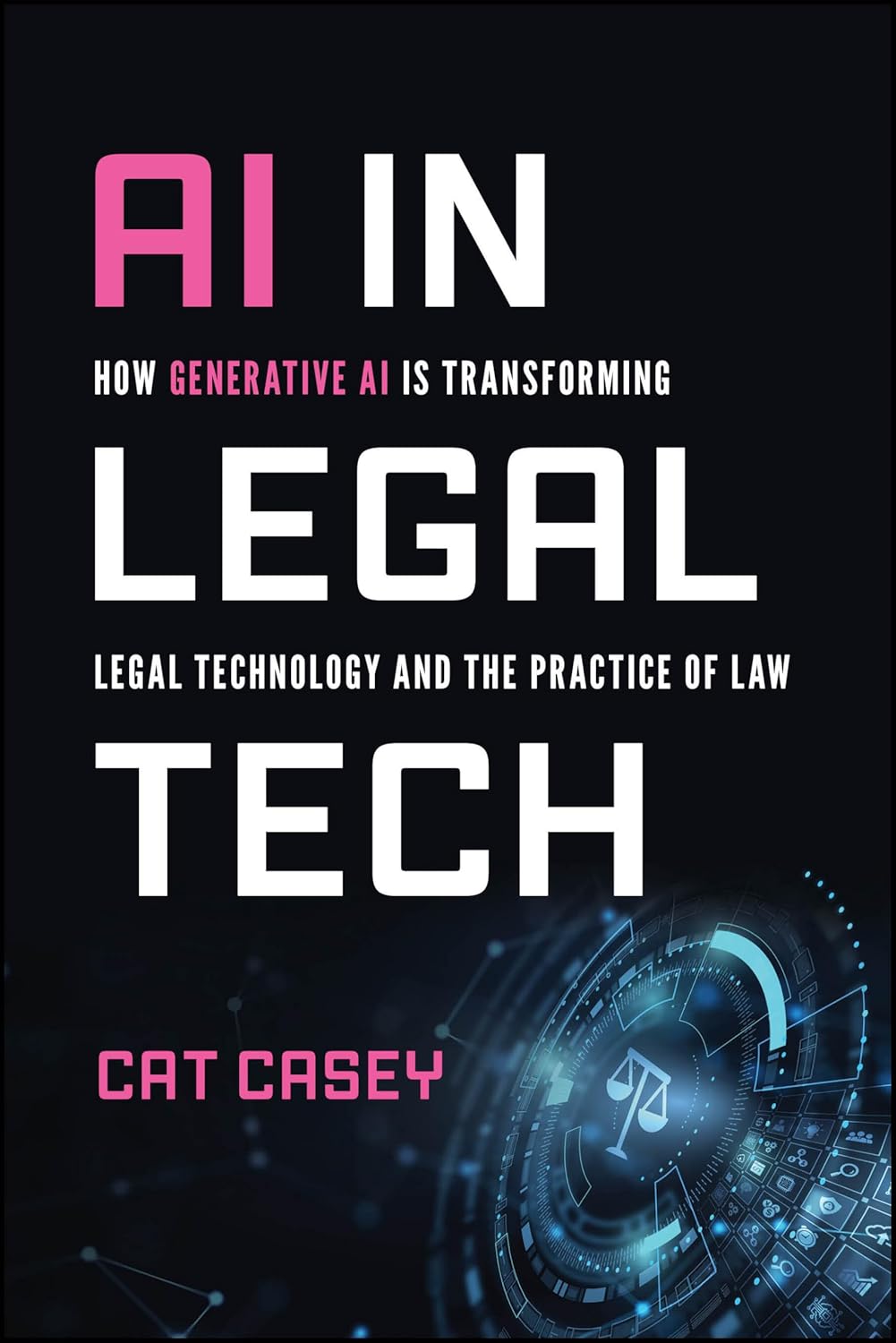
New at NYLI: AI in Legal Tech: How Generative AI is Transforming Legal Technology and the Practice of Law by Cat Casey
Artificial intelligence is no longer a future-facing concept in the legal field. It is already embedded in the tools attorneys use every day. For law librarians, this shift presents both an opportunity and a challenge: how do we translate rapidly evolving AI capabilities into meaningful, practical support for our users?
Cat Casey’s AI in Legal Tech offers a clear, accessible introduction to this landscape. While geared broadly toward legal professionals, it provides particularly useful context for those working at the intersection of legal research, technology, and instruction.
Below are key takeaways and their relevance for law librarians.
Understanding the “Flavors” of AI (Without the Hype)
One of the book’s strengths is its ability to demystify different types of AI without oversimplifying them. Casey distinguishes between:
- Machine learning
- Predictive analytics
- Natural language processing (NLP)
- Generative AI
This distinction is critical when evaluating legal technology, as AI encompasses a range of approaches with different capabilities and limitations.
Where AI Is Embedded in Legal Workflows
AI is not a separate category of tools; it is increasingly integrated into existing legal workflows. Casey highlights applications such as:
- eDiscovery and predictive coding
- Concept clustering and document classification
- Contract analysis and review tools
- Anomaly detection
- Matter and knowledge management systems
These examples reinforce that law librarians are supporting not just research tools, but AI-enhanced legal systems.
Challenges to Watch
The book also addresses the limitations of AI in legal contexts, including:
- Hallucinations (confident but incorrect outputs)
- Confidentiality risks, particularly with public tools
- Vendor opacity around training data and models
- Overreliance on AI-generated results
These challenges underscore the importance of critical evaluation, verification, and user education.
Final Thoughts
AI in Legal Tech is a strong, approachable introduction to a complex and rapidly evolving area. Casey combines technical explanation with practical application, making it a useful starting point for legal professionals and researchers seeking to better understand AI in practice.
For law librarians, the value lies in translating these insights into action such as supporting users, strengthening AI literacy, and ensuring these tools are used thoughtfully and effectively.
Available from NYLI in eBook format:
https://ebookcentral-proquest-com.nyli.idm.oclc.org/lib/nyli/detail.action?docID=32466908