Cracking the Code: Why Prince’s Dictionary Still Belongs on Every Researcher’s Desk by Lucy Curci-Gonzalez/ NYLI Executive Director
I’ve been working in law libraries for a long time—long enough to have been stumped more than once by an obscure, outdated, foreign, or plain weird citation. You know the kind: no context, acronym or abbreviation that makes sense, or no clear jurisdiction, and absolutely no interest in making your day easier.
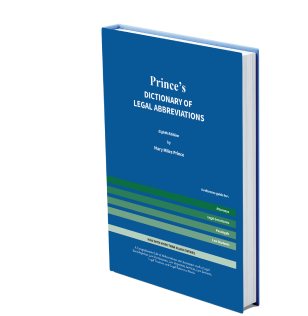
Over the years, my secret weapon for untangling these puzzles has been Prince’s Dictionary of Legal Abbreviations, and it remains a favorite. Truth be told, I still call it Bieber’s, which longtime legal researchers will immediately understand.
Yes, citations can be searched online now. But when you’re dealing with truncated legal citations that span decades and jurisdictions with shifting publishing conventions, various editors and authors, and title changes — a dependable, curated, and regularly updated print source is often faster and far more dependable, than chasing search results down a online rabbit hole. And Prince’s is even more comprehensive than the Blue Book’s appendices. Prince’s reverse dictionary is an invaluable feature when you know what you’re looking at—but not what it stands for.
One legal research site describes Prince’s (formerly Bieber’s) Dictionary as “a tool that helps researchers “crack the code”. That description couldn’t be more accurate. As a legal researcher, I can confidently endorse anything that truly functions as a secret weapon for cracking the code. Prince’s Dictionary earns that endorsement again and again. Sometimes, print tools really are the best.
By Emily Moog|February 2nd, 2026|Uncategorized|Comments Off on Cracking the Code: Why Prince’s Dictionary Still Belongs on Every Researcher’s Desk by Lucy Curci-Gonzalez/ NYLI Executive Director
Emily Moog is a Research Analyst at The New York Law Institute. Her career started as a page at The New York Public Library and she has worked for more than two decades as a law librarian in NYC, working at Cleary Gottlieb, Paul Weiss, and most recently at Carter Ledyard & Milburn LLP. Emily served on the LLAGNY Board, and is a frequent contributor to its newsletter, “Law Lines”. Emily's interest include legal research, New York City history and anything a little obscure!